
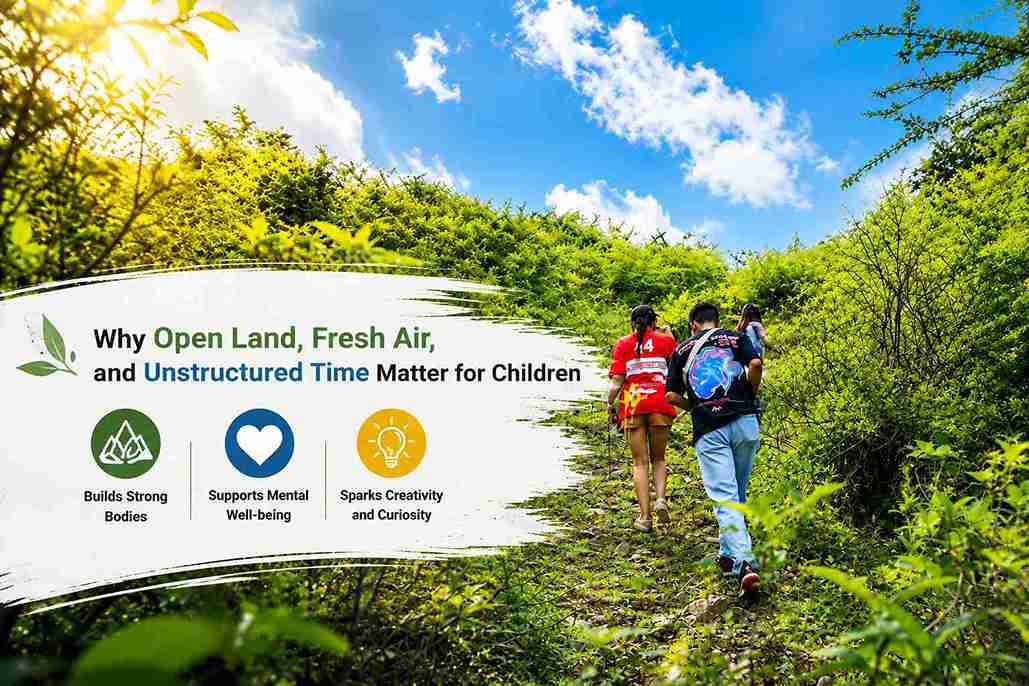
Childhood today has become significantly different from what it was 30 years ago. Most children spend a large part of their day indoors, in front of screens, with busy school schedules and study-related activities. While these activities are valuable in terms of education, free outdoor play has decreased rapidly, which is really a big issue.
In the past, childhood naturally included open spaces, fresh air, and long hours of unplanned play. Children learn by exploring, trying new things, making mistakes, and observing the world around them. Today, this balance is missing in busy urban lives.
Spending time in natural surroundings helps restore a healthy balance. It allows children to slow down, explore freely, and connect with the real world. Places like Aranyavas Farmstay and Nature Retreat offer families a simple, safe way to experience this lifestyle, giving children access to open land, clean air, and calm surroundings.
Shifting from Green Out-of-Doors to Digital Screens In most of the developing cities, safe and accessible green spaces are shrinking. As a result, children spend more time indoors using mobile phones, tablets, and television. This shift toward screen-based entertainment reduces necessary physical movement and limits real-world social interaction.
The Pressure of Over-Scheduled Routines Today’s children often follow tightly packed routines that include school, extracurricular activities, homework, and organized activities. While structured learning is important, constant scheduling leaves very little time for independent exploration. Unstructured play—where children use their own imagination without guidance-driven rules—is becoming rare.
Physical Growth Through Natural Movement: Unlike flat indoor floors, natural ground is uneven and varied. Running across open land, walking on natural trails, and moving around small slopes help children build physical balance, stamina, and core strength naturally.
Real Sensory Learning: Nature engages all five senses directly. Feeling the texture of soil, listening to the symphony of a variety of birds, watching the biodiversity of the farm, and observing farm animals creates strong mental connections and improve a child’s understanding of the physical world.
Building Confidence Through Small Risks: Indoor environments are highly controlled for safety, which gives children limited chances to test their limits. In an open sky, children learn to assess small, real-world risks independently—such as stepping across a stream or climbing a low rock. This builds genuine confidence and decision-making skills.
Better Physical Health and Sleep: Spending time in clean, pollution-free air, filled with the absolute freshness of nature, improves respiratory health. The combination of physical movement and fresh air naturally resets a child’s sleep cycle, leading to deeper and more restful sleep and mental stability.
Reducing Stress and Anxiety: Natural environments have a proven calming effect on the nervous system. Open horizons, green trees, and quiet surroundings help lower stress levels and improve a child’s overall mood.
Improved Focus and Attention: Continuous screen time causes mental fatigue. Spending time in quiet, green spaces allows a child’s mind to rest and reset. This breakdown from digital stimulation directly helps improve their focus and attention span when they return to their books.
Free Play Over Guided Learning: When children play with toys that have strict rules, their thinking is guided for them. When they are given basic natural elements—like open space, stones, or sticks—they must invent their own games. This unstructured time is essential for developing original creativity.
Practical Problem-Solving: Out in nature, children learn through trial and error. If a game they make up doesn’t work, or a path is blocked, they have to work out a solution on their own. This builds practical, real-world troubleshooting skills.
Social and Emotional Growth: Unstructured time needs children to manage their own boredom, share tasks, and cooperate with siblings or friends to create entertainment. This naturally teaches patience, clear communication, and emotional bonding.
Real-World Learning Outside Textbooks A living farmstay is an interactive educational space. Instead of just reading about nature, children see how plants grow, learn where their food comes from, observe farm life firsthand, and enjoy the sights and sounds of nature all around them—from the morning sunrise to the evening sunset.
A Natural Digital Detox When children are surrounded by engaging outdoor activities—like watching birds, strolling in a farm, trekking, or sitting by an evening bonfire—the urge to look at a phone or tablet naturally goes down. They disconnect from screens simply because the physical world around them is more interesting than the screen.
Quality Family Time Away from the daily chores and professional distractions of city life, a farmstay allows families to slow down together. Walking along natural trails, sharing simple outdoor activities, and talking under an open sky create lasting family bonds.
Aranyavas Farmstay and Nature Retreat in Manpura Macheri provides a secure, peaceful environment designed to give families a break from urban pressure.
Open land, fresh air, and unplanned time are not luxury items for a holiday—they are basic requirements for a working professional and a child’s physical, emotional, and mental growth. In a fast-paced, screen-heavy world, giving children time to experience simple nature is a powerful choice for their well-being.
A short stay in a natural environment does more than just fill a weekend; it helps the entire family reset and ground themselves in a peaceful lifestyle.
Ready to give your children the space to explore naturally? Plan a family visit to Aranyavas Farmstay and Nature Retreat, and rediscover the simple, unhurried joy of childhood in nature.
Q1: My child gets bored the moment they drop their iPad. How will they handle “unstructured time” at the farmstay?
A: Boredom is actually the first step toward creativity. When children first arrive, they might experience a brief period of restlessness without digital stimulation. However, because Aranyavas offers an expansive, tactile environment—filled with farm animals, open fields, nature trails, and the constant beauty of birds and sunsets—their natural curiosity quickly takes over. Once they realize there are no pre-set digital rules, they naturally begin inventing their own games using basic elements like sticks, stones, and open land.
Q2: Is the uneven, natural terrain of Farmland near Jaipur safe for children used to flat city floors?
A: Yes, and it is actually essential for their physical growth. While modern urban lives keep children on flat concrete or tiled floors, the naturally varied terrain at Aranyavas—gentle slopes, dirt tracks, and farm acreage—is carefully monitored and secure. Navigating these minor, real-world variations helps children build core strength, physical balance, and independent risk-assessment skills within a protected environment.
Q3: How does a weekend at Aranyavas help reverse the “mental fatigue” of an over-scheduled school routine?
A: Tight urban schedules and constant screen time cause what psychologists call cognitive fatigue. The open horizons, mature trees, and quiet countryside surroundings of Manpura Macheri act as a sensory reset. By removing targeted digital stimuli and rigid rules for just a weekend, a child’s nervous system relaxes. This mental intermission directly sharpens their focus and attention span by the time they return to their schoolbooks.
Q4: What makes a “farmstay classroom” better for a child’s development than an urban park or playground?
A: Traditional city parks are highly controlled, manicured, and often filled with rigid play structures that guide a child’s movement. A living farmstay like Aranyavas is a fluid, interactive ecosystem. Here, children experience real learning—they see exactly how food grows, feel the changing textures of natural soil, hear the sounds of local birds, and witness the authentic rhythms of rural life. It turns passive recreation into active, independent exploration.
Q5: Can a short weekend trip truly create a lasting “digital detox” for my children?
A: A weekend stay won’t permanently change habits, but it works as a powerful “pattern interrupt.” When children experience how genuinely satisfying it feels to run across open land, watch the sunset, or sit by a real evening bonfire, their dependency on screen-based entertainment drops. It shows them that the physical world is far more interesting than a digital screen, giving families a healthy baseline to recreate mindful habits back home in the city.
Q6: How do we practice “unstructured play” as a family during our stay at Aranyavas?
A: The key is to avoid over-scheduling your itinerary while you are here. Instead of guiding your children through back-to-back activities, give them unplanned time. Let them lead a walk down our secure farm trails, encourage them to gather fallen twigs or stones, or simply sit under the open sky and watch the birds. Our role as adults is simply to provide a safe space and let their imagination run the show.
Q7: Why is “fresh air” in a rural setting like Manpura Macheri different for a child’s health than air-purified indoor spaces?
A: Air purifiers remove particles, but they cannot replicate the benefits of raw, oxygen-rich natural environments. The crisp, pollution-free countryside air of our retreat, filled with the freshness of nature, combined with active physical movement, naturally stimulates respiratory health. This clean oxygen intake reduces the stress levels in children and helps naturally reset their circadian rhythms, leading to noticeably deeper, more restful sleep during and after their stay.
Q8: My children are very young. Will they be able to handle the practical problem-solving elements mentioned in the article?
A: Absolutely. Practical problem-solving in nature scales naturally with age. For a toddler, it might mean figuring out how to step over a small muddy patch on a farm trail. For an older child, it might involve figuring out how to build a small fort with fallen branches or coordinating a game with a sibling. Because the natural elements at Aranyavas are open-ended, children of all ages intuitively find ways to test their limits and build self-reliance.
Q9: How does the unhurried lifestyle at Aranyavas specifically improve family bonding compared to a typical resort holiday?
A: Commercial luxury resorts often pull family members in separate directions with televisions, game zones, and crowded dining halls. Because Aranyavas is designed around a quiet, slower lifestyle, it naturally brings the family unit back together. Walking side-by-side along quiet trails, watching the sunrise and sunset, sharing farm-to-table meals made from fresh local produce, and having uninterrupted conversations under an unpolluted sky allow parents and children to reconnect without the constant pings of urban distractions.
Q10: Is a nature retreat like this suitable for a single parent traveling with an Only Child? A: It is highly rewarding. For an only child who often relies on screens for entertainment at home, the open spaces of Aranyavas become an active companion. Single parents find that the unhurried rhythm allows them to engage in deep, imaginative play alongside their child without the pressure of household chores or professional notifications. It provides a rare, shared canvas for one-on-one emotional bonding amidst the calming sights and sounds of nature.

We’re excited to help you plan your experience at Aranyavas. Please share your details below, and we’ll get in touch with you within 2 working days