
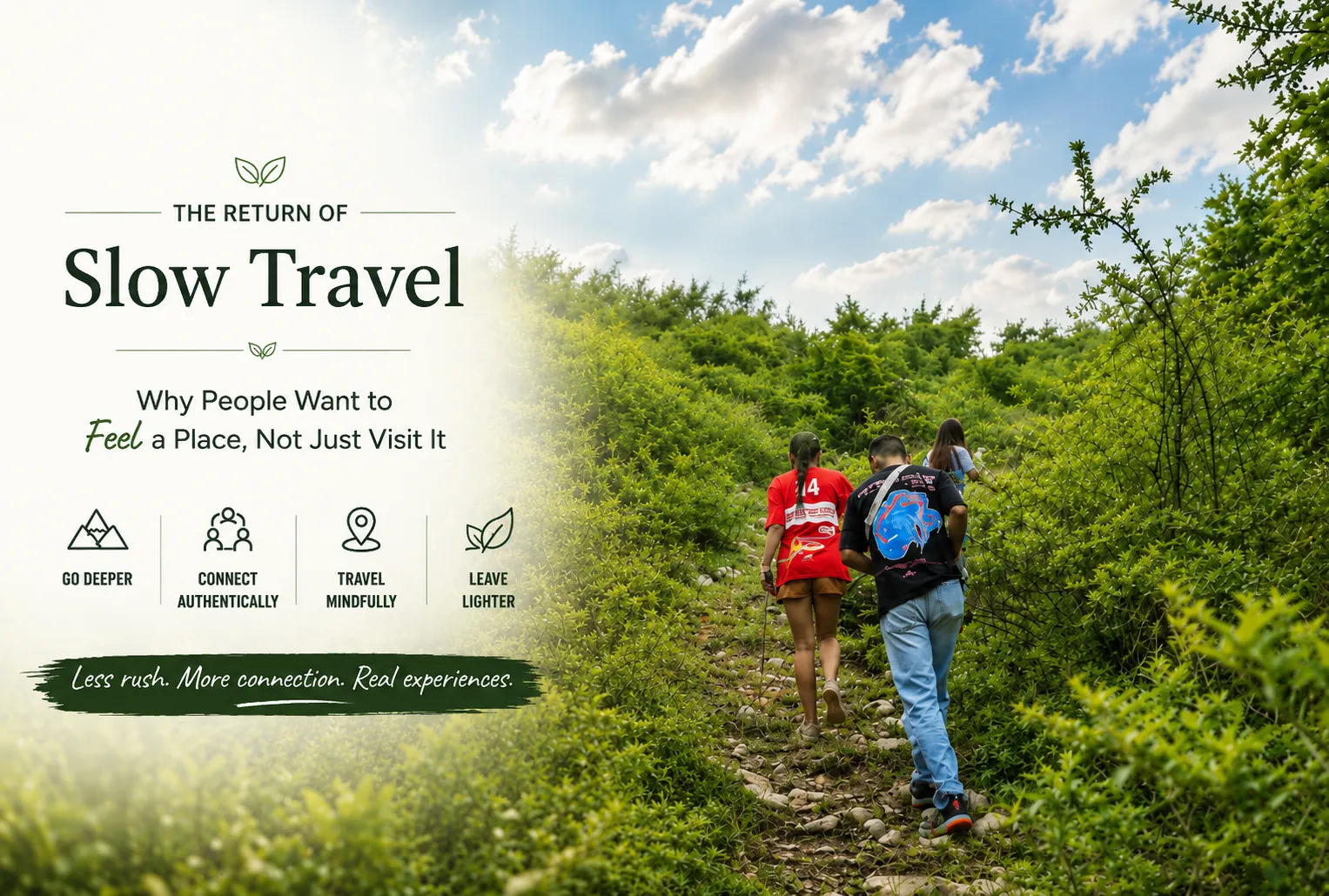
Slow Travel in Rajasthan: How to Experience a Destination, Not Just Visit It
Modern travel makes it possible to see more places than ever. Flights, trains, and carefully planned itineraries can take you from one destination to another in a short time.
Yet there is a paradox: you can visit multiple places in one trip and still return home feeling that you barely experienced any of them.
Imagine a different kind of journey in Rajasthan. You start in the morning with a walk through an organic farm. You notice how the crop is grown, take time to appreciate the crafts around you, and enjoy a regional breakfast. Later, you find yourself wandering through a market, speaking with a local shopkeeper or craftsperson, and perhaps staying longer than planned because something catches your attention. You leave the rest of the day open, allowing the destination itself to decide where you go next.
That is the essence of slow travel.
Instead of asking, “How many places can I see?”, slow travel asks, “How deeply can I experience this place?”
And Rajasthan offers plenty of ways to do exactly that. Its forts, Aravalli landscapes, and palaces are only part of the experience. Its cuisine, crafts, markets, music, traditions, landscapes, and everyday cultural life can turn a conventional sightseeing trip into a more immersive journey. Rajasthan Tourism itself describes the state through its combination of heritage, diverse culture, cuisine, landscapes, music, and art.
Slow travel is a way of exploring a destination with greater intention. It prioritizes meaningful experiences, local connections, and time to appreciate your surroundings instead of trying to fit as many attractions and destinations as possible into one itinerary.
It does not necessarily mean taking a long holiday.
A three-day Rajasthan getaway can follow slow-travel principles if you stay focused on one destination and give yourself enough time to become familiar with it. Conversely, a longer trip can still feel rushed if every hour is filled with another attraction or transfer.
The idea is simple: give yourself enough time to notice where you are and let the place influence what you do next.
Slow travel is about depth, not speed: The focus is on experiencing a destination rather than trying to visit as many places as possible.
You don’t need a long holiday: Even a three-day Rajasthan trip can follow slow-travel principles when fewer destinations and flexible plans are prioritized.
Look beyond major attractions: Markets, food, crafts, architecture, music and everyday local life can add depth to a Rajasthan trip.
Stay longer and leave breathing room: Extra time creates opportunities for local recommendations, unexpected discoveries, and unplanned experiences.
Rajasthan offers varied slow-travel experiences: Jaipur, Pushkar, Udaipur, and Jaisalmer each offer different combinations of heritage, markets, food, culture, and landscapes.
Slow travel is not the same as sustainable tourism: a slower pace may support responsible choices, but sustainability also depends on transport, accommodation, resource use, and traveler behavior.
There is no fixed slow-travel itinerary: Planning should create a practical framework while leaving enough flexibility to follow genuine interests and local discoveries.
The right destination is the one worth staying in: The article’s central message is that travelers should choose places that create curiosity and connection rather than simply chasing the longest attraction list.
Slow Travel vs. Fast-Paced Travel
Fast-Paced Travel | Slow Travel |
More destinations | Fewer destinations |
Packed itinerary | Flexible days |
Major attractions dominate | The destination itself becomes the focus |
Frequent transfers | More time in one place |
“What’s next?” | “What interests me here?” |
Slow travel does not mean skipping Rajasthan’s famous attractions. It means not allowing a checklist to determine your entire experience. You might visit a famous fort, but you might also spend an unexpected hour in a market, linger over a meal, follow a local recommendation, or simply sit and observe everyday life.
Rajasthan is often introduced through its forts, palaces, and royal heritage. But the state’s tourism experience extends much further.
Beyond its forts, palaces, and bazaars, Rajasthan offers travellers traditional crafts, regional cuisine, music, dance, rural experiences, and diverse landscapes to explore at a more relaxed pace.
That diversity gives travellers many reasons to stay in one place and let their curiosity guide the day.
Visit the major attraction if it interests you, but do not make it the entire experience.
In Jaipur, for example, you can combine the city’s architectural heritage with time in its traditional markets. Rajasthan Tourism lists Johari Bazaar, Nehru Bazaar, Bapu Bazaar, and other shopping areas among Jaipur’s established shopping destinations.
You do not need to decide in advance how long you should spend in each place. You might begin by exploring the Old City, notice a particular craft or street that interests you, and decide to spend more time there. The Old City offers much more than traditional tourist attractions, with its architecture, markets, crafts, colours, food, and everyday rhythm.
Markets can reveal a side of a destination that a sightseeing checklist cannot.
Rajasthan Tourism describes Rajasthan as a destination known for colorful arts and crafts, including jewelry, textiles, paintings, and pottery. It also identifies Jaipur’s Kundan and Meenakari jewelry traditions and Pratapgarh’s Thewa craft.
In Pushkar, for instance, the main market offers silver jewelry, embroidered clothing, leather goods, and decorative items, while cafés around Pushkar Ghat provide opportunities to experience local food and the atmosphere around the lake.
A slow traveler does not simply pass through these markets looking for a particular item. There is time to browse, notice something unexpected, ask questions, understand the craft, or simply enjoy the atmosphere before deciding where to go next.
Food is another way to experience a place.
Eat at a local establishment. Take your time. Ask about the dish. If you discover something you enjoy, there is no need to rush through the meal simply to reach the next stop.
A meal can become one of the experiences you remember most, particularly when it leads to a conversation, a local recommendation, or a better understanding of the region.
To experience Rajasthan, look beyond a list of monuments.
Listen to traditional music when you happen to encounter it. Explore a local market because something catches your attention. Learn about a craft because you are curious about how it is made. Taste regional food. Walk through a historic neighborhood without deciding that you have to reach the next attraction within a particular time.
The point is not to collect experiences. It is to remain open to them.
Rajasthan’s heritage can be experienced through more than individual monuments.
In cities such as Jaipur and Udaipur, architecture, markets, streets, and cultural spaces come together to create a broader sense of place.
If a historic building, street, courtyard, market, or architectural detail catches your attention, give yourself permission to spend time with it. You do not need to rush towards the next landmark simply because it appears on a list.
Rajasthan’s crafts offer a direct connection to its artistic traditions.
The state’s official tourism material highlights jewelry, textiles, pottery, paintings, metalwork, and other handicrafts. Jaipur is particularly associated with Kundan and Meenakari jewelry, while Thewa is associated with Pratapgarh.
When possible, look beyond simply purchasing a souvenir. If a particular craft interests you, take time to understand its technique, design, history, and tradition. Let your curiosity decide how deeply you want to explore it.
Music, dance, festivals, customs, and traditional arts form an important part of Rajasthan’s cultural identity. Rajasthan Tourism describes music, art, and dance as deeply woven into the state’s cultural life.
You do not need to build your entire day around finding a cultural performance. If you encounter one during your stay, or if a local recommends an experience that genuinely interests you, follow that curiosity. The experience becomes more meaningful when it is discovered rather than simply ticked off a list.
Rajasthan is not defined by its cities alone.
The state’s varied landscapes create opportunities for outdoor and rural experiences, from desert settings to the Aravalli landscape and other natural areas.
The key is not to move through these landscapes simply to say you have been there. Stay long enough to notice the setting, whether that means walking, sitting quietly, observing local life, or allowing an unplanned moment to become part of your journey.
A slow Rajasthan journey can include many different experiences depending on your destination and interests:
The goal is not to complete all of these experiences. You may discover none of them on a particular day, and that can still be slow travel. What matters is having enough time and freedom to follow what genuinely interests you.
You do not need to completely redesign your holiday. A few changes can make a Rajasthan trip feel considerably less rushed.
Choose fewer destinations: Instead of adding another city simply because it fits on the map, consider spending an additional day where you already are.
Stay longer: An extra night can create space for a market visit, a long local meal, an unexpected conversation, or simply time to enjoy the destination without a plan.
Leave breathing room: Do not schedule every morning and evening. Open time gives you the freedom to follow a local recommendation, stay somewhere you enjoy, or change your plans altogether.
Explore locally: Look for credible local guides, cultural experiences, craft activities, and other locally rooted experiences, but allow yourself to decide what genuinely interests you rather than trying to experience everything.
Walk where practical: Exploring a suitable heritage area or market on foot can reveal details that are easy to miss from a vehicle.
Eat locally: Try regional dishes and ask knowledgeable local hosts for recommendations. Let a conversation about food lead you to something you might not otherwise discover.
Shop thoughtfully: Rajasthan’s crafts are closely connected to its cultural traditions. Take the time to understand what you are buying and where it comes from.
Learn before you arrive: A little knowledge of local customs, history, and etiquette can make cultural experiences more meaningful.
Put the phone away sometimes: Photographs are part of travel, but not every experience needs to be viewed through a screen.
Most importantly, do not feel that every empty hour needs to be filled. In slow travel, an unplanned afternoon is not wasted time.
Slow travel does not have to revolve around the state’s biggest tourism centers.
Rajasthan offers a broad range of destinations, each with its own character, heritage, and landscape. The official Rajasthan Tourism website presents numerous destinations across the state beyond the most familiar names.
Choosing a less familiar destination can allow travelers to explore a different side of Rajasthan and spend more time engaging with the place rather than moving between major attractions.
The objective is not simply to find somewhere with fewer visitors. It is to find somewhere that gives you a reason to stay, explore, and remain curious.
Sometimes that may be a historic town. Sometimes it may be a landscape, a market, a local tradition, or simply the atmosphere of a place that makes you want to stay a little longer.
Slow travel and sustainable tourism are related, but they are not the same.
Slow travel describes how you experience a destination—your pace, choices, and mindset. Sustainable tourism is concerned with the environmental, social, and economic impact of tourism.
Staying longer in one place may reduce the need for frequent transfers, but slow travel should not automatically be described as sustainable. The overall impact depends on factors such as transport, accommodation, resource use, and visitor behavior.
Travellers can make more responsible choices by:
The principle is straightforward: experience Rajasthan while respecting the people, culture, and environment that make the destination special.
Slow travel does not require a detailed itinerary.
Start by selecting a place that genuinely interests you and give yourself enough time to become familiar with it.
Know what is available, but do not feel obliged to experience everything.
You might begin the morning with no fixed destination. Perhaps you wander through a market and find a craft that interests you. Perhaps you stop for breakfast and end up talking with someone about the area. Perhaps you discover a historic street and decide to explore it for longer than expected. Or perhaps you simply find a quiet place and enjoy being there.
The next part of your day can emerge from that experience.
This does not mean travelling without any preparation. Transport, accommodation, opening hours, weather, local customs, and important reservations may still require planning. The difference is that planning creates the framework; it does not control every moment of the journey.
Leave enough space for the unexpected.
That is where much of the character of a destination can reveal itself.
There is no single “best” slow-travel destination in Rajasthan. Different destinations offer different experiences, and the right choice depends on what genuinely interests you.
Jaipur allows travelers to combine its architectural heritage with markets, crafts, food, and cultural experiences. Rajasthan Tourism highlights the city’s shopping areas and specialized city tours designed to explore the character of the Pink City.
A slower Jaipur experience does not need to follow a fixed sequence of attractions. You might explore the Old City, spend time in a market that catches your attention, stop for local food, or simply wander through an area without worrying about how many places remain on your list.
Pushkar offers a different pace, with its lake, temples, markets, and food experiences.
Rajasthan Tourism describes its market as a substantial shopping area featuring jewellery, embroidered clothing, leather goods, and decorative items. It also highlights local street food and cafés around Pushkar Ghat.
Instead of treating Pushkar as a quick stop, travelers can give themselves time to explore the town on foot, browse its markets, sit by the lake, and experience its distinctive atmosphere. What comes next can depend on what they discover along the way.
Udaipur offers opportunities to combine its lakes and historic architecture with markets and cultural experiences.
Rajasthan Tourism’s own travel material highlights markets such as Hathi Pole, Jagdish Chowk, and Ghanta Ghar, as well as cultural performances at Bagore Ki Haveli.
A slower visit can balance sightseeing with time spent exploring markets, enjoying the city’s lakeside setting, or following an unexpected recommendation from someone who knows the city well.
Jaisalmer provides another perspective on Rajasthan through its desert landscape and experiences around the Thar.
Rather than limiting a visit to the fort or trying to fill every available hour with activities, travelers can give themselves time to appreciate the architecture, explore the surrounding area, spend time in the desert landscape, or discover local experiences that genuinely interest them.
Travellers willing to explore beyond the familiar circuit can discover destinations such as Bundi, Banswara, Karauli, or Dausa, each offering a different combination of heritage, culture, and landscape.
For a slow-travel journey, the best destination is often not the one with the longest list of attractions. It is the one where you find enough character, curiosity, and connection to make staying an extra day worthwhile.
Slow travel is not a rule that every traveler needs to follow.
It works particularly well for:
But fast-paced travel can also make sense.
If you have only a short window, are travelling for a specific event, or have several places you genuinely want to experience, a structured itinerary may be appropriate.
Slow travel is ultimately about intentionality, not a fixed number of days.
What exactly is slow travel?
Slow travel is a way of exploring a destination by prioritizing meaningful experiences, local connections, and a comfortable pace rather than trying to visit as many places as possible. It leaves room for curiosity and allows travelers to decide what interests them as the journey unfolds.
Why is slow travel becoming popular?
It offers an alternative to highly packed itineraries. Instead of moving constantly between attractions, travelers have more time for local food, culture, heritage, nature, conversations, and unexpected discoveries.
Is slow travel more expensive?
Not necessarily. Staying longer can increase accommodation and meal costs, but reducing frequent transfers and destination changes can also reduce some travel expenses. The overall cost depends on your accommodation, transport, and travel style.
How many days do you need for slow travel?
There is no fixed number. Even a short Rajasthan trip can follow slow-travel principles if you choose fewer destinations and leave enough time to experience each place without filling every hour with planned activities.
Is slow travel sustainable?
Not automatically. Slow travel can support more responsible choices, such as staying longer and spending with local businesses, but sustainability depends on the complete journey, including transport, accommodation, resource use, and visitor behavior.
What are some good slow-travel experiences in Rajasthan?
Heritage exploration, local markets, regional cuisine, craft discovery, cultural encounters, rural experiences, nature, and locally operated experiences can all form part of a slow Rajasthan journey. The important point is not to complete a list but to remain open to what interests you.
How do I plan a slow travel journey in Rajasthan?
Choose fewer destinations, stay longer, understand what is available, and leave gaps between planned activities. Make practical arrangements in advance where necessary, but allow enough flexibility for local recommendations, unexpected discoveries, and moments when you simply want to stay where you are.
What is the difference between slow travel and sustainable travel?
Slow travel is primarily about how you experience a destination—your pace and mindset. Sustainable tourism is about the environmental, social, and economic impacts of tourism. The two can overlap, but they are not interchangeable.
Rajasthan can be photographed in a day, but it cannot truly be experienced that quickly.
To experience the state, you may need to stay a little longer. Wander through a local market without knowing exactly what you will find. Take time to taste a regional dish, discover the story behind a traditional craft, or explore a historic neighborhood without rushing to the next attraction.
Take the slower road. Spend time in a different landscape. Listen to the sounds of a local street. Watch the colors of Rajasthan change as the sun sets.
And if you find something that interests you, stay with it.
These are the moments that turn a journey into a lasting memory.
Rajasthan is more than its forts, palaces, and famous attractions. It is found in its food, crafts, music, markets, landscapes, traditions, and stories—and in the everyday experiences that make each destination unique.
So, on your next journey, don’t ask only:
“What can I see?”
Ask:
“What can I experience, understand, and remember?”
That is the real promise of slow travel in Rajasthan—not travelling less, but giving yourself enough time to truly feel the place.

We’re excited to help you plan your experience at Aranyavas. Please share your details below, and we’ll get in touch with you within 2 working days