
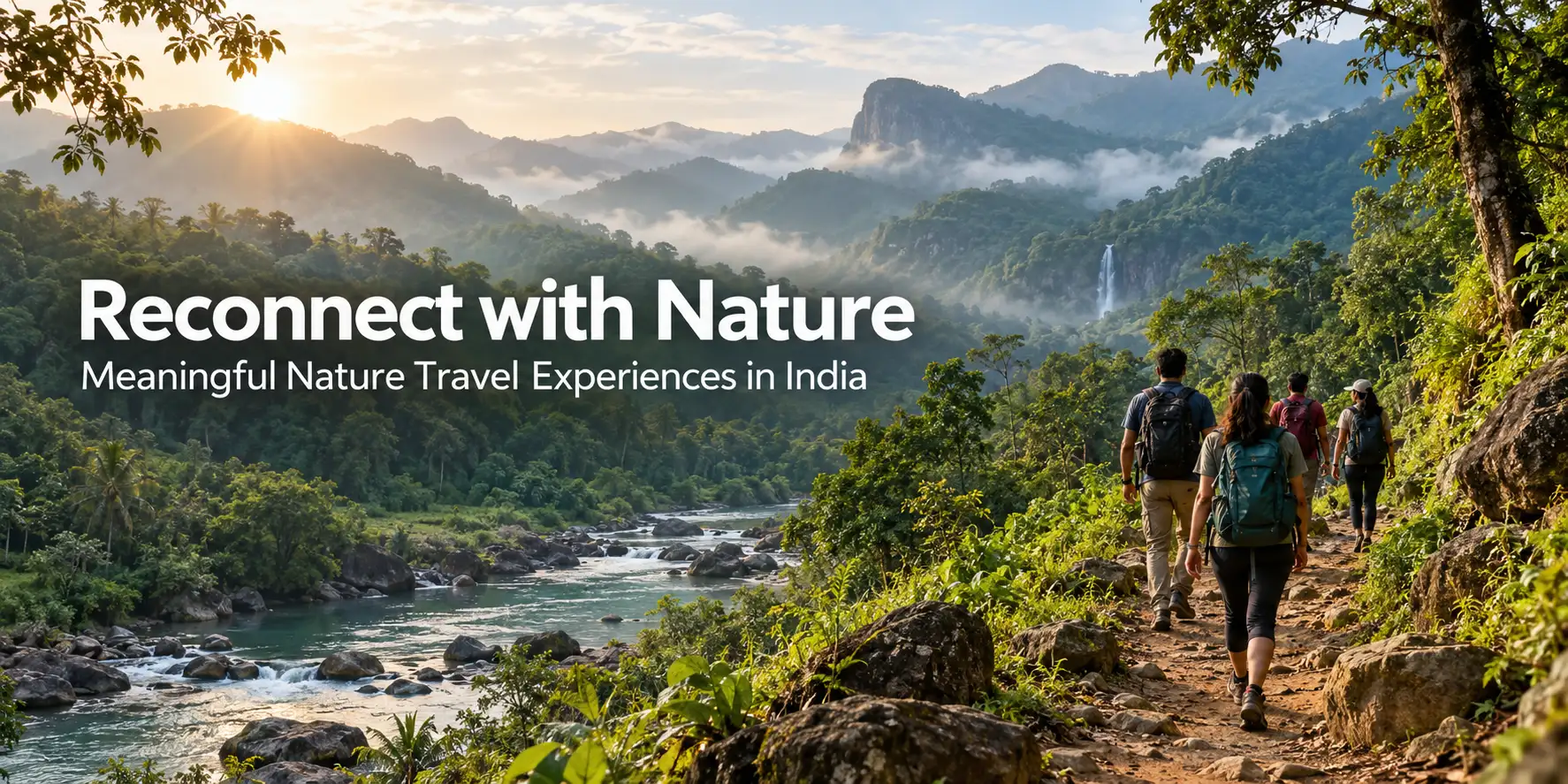
For many travellers, reconnecting with nature means slowing down and experiencing a destination beyond sightseeing. From Himalayan trails and wildlife safaris to Kerala’s backwaters, rural villages, and coastal ecosystems, India offers diverse opportunities to experience nature more deeply and responsibly.
You wake before sunrise. There is no traffic outside the window, no fear of notifications waiting on your phone, and no hurry to get somewhere.
Instead of car and scooter horns, there is birdsong. Wind moving through the trees. The distant sound of water. You step outside and realize that, for once, there is nowhere you need to be immediately.
For many travellers, this is what reconnecting with nature really means.
It is not essential to find the most remote forest, climb the mountain, or spend days completely disconnected from crowds. It can be a walk through a forest with a local naturalist, a morning watching birds beside a wetland, a slow boat ride through Kerala’s backwaters, a village meal made with local ingredients, or an evening spent watching the landscape change after sunset.
The destination matters, but so does the way you experience it.
And India offers huge opportunities for that kind of travel. From the Himalayas and Western Ghats to the Thar Desert, wetlands, forests, backwaters, and islands, the country’s landscapes create very different ways to slow down and experience the natural world.
The question is not simply where to go.
It is how deeply you want to experience the place once you arrive.
Reconnecting with nature means giving yourself enough time and attention to experience the natural environment rather than passing through it.
A mountain is more than a viewpoint. A forest is more than background for photographs. A river is more than a stop between two attractions.
Assume starting your day with a forest walk. Instead of simply following a trail, you experience nature and get the fragrance of the soil. You hear the different birds’ calls, notice changes in vegetation, and understand how the landscape supports wildlife.
Or consider a rural stay where the experience includes a local meal, a walk through nearby fields, and a conversation with people who have lived alongside that landscape for generations.
These experiences make nature feel less like something you look at and more like something you understand.
That is the difference between seeing a landscape and experiencing a place.
A holiday can sometimes feel surprisingly similar to everyday life: schedules, notifications, traffic, crowded spaces, and a long list of things to accomplish.
For travellers coming from metropolitan cities, a mountain village, forest landscape, or rural destination provides a completely different environment.
The day may start with a stroll rather than a trip somewhere. Lunch might be prepared from fresh vegetables from the nearby farm. You might spend the afternoon by the farm instead of inside a shopping center.
An attraction isn’t always a specific activity.
Sometimes, it is simply a matter of having fewer things vying for your attention.
Technology remains useful while travelling. Phones provide directions, bookings, communication, and emergency access.
But a nature experience can also create opportunities to use them less.
You might switch off your phone during a forest walk, leave your phone in your room during breakfast, or spend an evening enjoying the surroundings without documenting every moment.
The idea is not to reject technology.
Nature also fits naturally into wellness travel.
A morning walk in the beautiful landscape, yoga beside a garden, meditation near water, or simply getting enough sleep away from a busy urban environment can become part of a restorative trip.
The experience does not need to resemble a formal retreat. Sometimes, changing the surroundings changes the pace of the day.
A photograph can capture the scenery of a place, but it cannot capture the experience and memories it can make.
Things like the scent of rain on a forest path, the sound of birds before sunrise, a conversation with a local guide, a meal cooked in a village kitchen on a chulha, or the shifting colors of a mountain valley.
It is these subtle details that transform a journey into a memorable experience.
A traveller can visit an extraordinary natural destination and still experience very little of it.
There is nothing wrong with photography, and sightseeing at popular viewpoints and landmarks is part of travel.
But nature reveals itself more when travelers give it time.
Instead of photographing a forest from the roadside, walk through it with someone who knows the landscape.
Instead of rushing through a mountain destination, take a village trail and try the local meal.
Instead of treating a wetland as another attraction, spend an early morning watching birds and observing how the ecosystem comes alive.
The difference is not necessarily the destination.
It is the depth of attention.
A one-day visit may show you a destination’s highlights.
A longer stay can reveal its character.
On the first day, you might visit the famous landmarks. By the third day, you might watch the market come to life in the morning, recognize familiar faces, discover a quiet route for a stroll, or understand how the local food is connected to the surrounding atmosphere.
This is where slow travel becomes valuable.
The objective is not to eliminate sightseeing. It is to leave enough room for the experiences that cannot be scheduled neatly into an itinerary.
There is no single version of a nature holiday.
For one traveler, it could be trekking; for someone else, it is birdwatching beside a lake. Someone else might prefer a houseboat, a rural homestay, or a quiet coastal escape.
What connects these experiences is the opportunity to spend meaningful time within a landscape.
A forest trail can become interesting when you stop treating it as a route from one point to another.
Walk slowly. Notice the sounds around you. Look for birds and insects. Learn about native plants. Let a local naturalist explain how the ecosystem works.
The experience is not simply about entering a landscape.
It is about noticing what is happening inside it.
Wildlife travel offers perhaps the clearest example of the difference between seeing and experiencing nature.
A safari is not a guarantee that an animal will be seen. The anticipation is part of the experience.
In Rajasthan, destinations such as Sariska National Park offer opportunities to explore landscapes of dry deciduous forests, grasslands, and rocky terrain while looking for wildlife and birds.
Elsewhere in the state, the Desert National Park represents a very different ecosystem, while Tal Chhapar is particularly relevant to travelers interested in birds and the blackbuck.
A responsible wildlife experience allows animals to remain wild. The goal is observation, not interference.
Mountain travel naturally changes the pace of a journey.
In Uttarakhand, travellers can combine Himalayan landscapes with trekking, village experiences, and outdoor activities. The state’s official tourism highlights destinations and experiences ranging from high-altitude landscapes to rafting, kayaking, and mountain trails.
Imagine starting the morning with a village walk, following a mountain trail with a local guide, stopping for a simple regional meal, and returning as afternoon light settles across the valley.
The summit may be memorable. But the journey towards it can be even more so.
Some landscapes, like Rajsthan, encourage slow travel almost naturally.
Kumarakom, another in Kerala, sits along Vembanad Lake, surrounded by interconnected waterways, greenery, and village landscapes. The area offers access to the Kumarakom Bird Sanctuary, where visitors can experience the migratory and resident birdlife.
Here, reconnecting with nature means taking a boat through the backwaters, watching birds near the wetlands, walking around the village, or simply allowing the landscape to unfold without constantly checking the clock.
The journey itself becomes the experience.
Nature by the sea can be just as immersive.
The Andaman and Nicobar Islands offer a combination of beaches, forests, birdlife, and marine ecosystems. The Mahatma Gandhi Marine National Park near Wandoor protects coral reefs and marine life across a group of islands and surrounding waters.
A coastal nature holiday could involve exploring marine environments, spending time on quieter stretches of coast, or learning about the ecosystems that exist beneath the water.
The sea is not simply scenery.
It is an ecosystem to experience responsibly.
Rural tourism can reveal another side of nature travel.
Instead of seeing fields or villages from a vehicle, travelers can spend time understanding how the local people live.
Menar in Rajasthan is a case in point; its lakes and protected wetlands are home to a variety of birds, and the village offers an opportunity to experience both the natural environment and the local culture.
A day here might involve birdwatching in the wetlands, exploring the village, learning about local traditions, and sharing food prepared in the community.
The result is not simply a nature experience.
It is a better understanding of the relationship between landscape, livelihood, and culture.
One of the most rewarding aspects of nature travel is discovering that landscapes do not exist separately from the people who live around them.
A river can shape settlement patterns. A mountain can influence agriculture and architecture. A coastal environment can influence food traditions. Forests can become part of local knowledge and livelihoods.
Understanding these connections adds another layer to travel.
Food can be an entry point into local culture.
A regional meal can tell you about the crops grown nearby, ingredients traditionally available in the area, and the ways communities have adapted their cooking to the local environment.
Instead of eating only between sightseeing stops, travelers can visit a local market, learn how a regional dish is prepared, or choose locally operated restaurants.
Local guides, artisans, farmers, and homestay hosts can provide context that a standard sightseeing itinerary cannot.
These interactions turn a landscape from something unfamiliar into something with a story.
A homestay can provide a different perspective from conventional accommodation.
The objective should not be to turn someone’s daily life into an attraction. It is to create respectful opportunities for visitors to understand the destination through local perspectives.
Often, these simple encounters become the moments travellers remember most.
India’s geographical diversity means that reconnecting with nature can look completely different from one region to another.
| Factor | Online or ODL Learning | Full-time Residential Learning |
|---|---|---|
| Flexibility | Higher | Lower |
| Location requirement | Usually limited, but program-specific | Regular campus presence required |
| Peer interaction | Mainly digital | Frequent in-person interaction |
| Field and industry exposure | Depends heavily on course design | Usually easier to integrate into the curriculum |
| Networking | Virtual and provider-dependent | Stronger campus-based interaction |
| Career support | Varies considerably | Often more structured, but institution-specific |
| Suitable for | Working professionals, entrepreneurs, and remote learners | Students seeking an immersive management experience |
Look towards quieter rural landscapes, Himalayan villages, and slower destinations such as Kumarakom.
The experience is less about ticking attractions off a list and more about allowing the surroundings to set the rhythm of the day.
Rajasthan, Madhya Pradesh, and Assam offer different wildlife landscapes and experiences.
Rajasthan alone demonstrates how varied nature travel can be: the forests of Sariska, the desert ecosystem of Desert National Park, and the bird-rich environment of Tal Chhapar offer very different encounters with nature.
Uttarakhand, Himachal Pradesh, and Sikkim offer Himalayan landscapes where walking, outdoor adventure, and local experiences can become part of the journey.
In Uttarakhand, for example, travellers can combine mountain trails with village experiences and activities on rivers and lakes.
Kerala’s backwaters offer a slower relationship with water, while the Andaman and Nicobar Islands provide access to coastal and marine environments.
Kumarakom combines backwaters, wetlands, birdlife, and village landscapes, making it particularly suited to travelers who want nature without an itinerary built entirely around adventure.
Rural destinations offer opportunities to connect nature with food, traditions, and community life.
Menar in Rajasthan is a useful example, combining village culture with lakes, wetlands, and birdwatching.
The best destination, therefore, is not simply the one that looks most impressive online.
It is the one that matches the experience you want to have.
A nature-focused trip does not require an elaborate itinerary.
Decide what you want from the journey before choosing the destination.
Do you want wildlife, mountains, water, rural life, adventure, photography, or simply a quieter environment?
That answer can guide the rest of the trip.
Rather than filling each day with attractions, choose a few experiences that allow you to interact with the destination.
The aim is to create a journey rather than a checklist.
Some of the best travel experiences cannot be booked in advance.
Leave an afternoon free. Walk through a local market. Ask your guide about places residents enjoy. Spend longer at a viewpoint instead of immediately moving to the next stop.
A little unplanned time can reveal the character of a destination.
You will have different weather in different seasons.
Wildlife activity, bird migration, mountain access, monsoon conditions, and water-based activities can vary throughout the year.
Before travelling, check current information from the relevant tourism, forest, or protected-area authorities, particularly when visiting wildlife reserves, mountains, or environmentally sensitive areas.
A deeper connection with nature means recognizing that these landscapes are not simply there for visitors.
They are habitats, ecosystems, and, in many cases, places connected to local livelihoods and communities.
Do not feed animals, attempt to attract them, or approach them for photographs.
Follow instructions from park authorities, guides, and conservation teams.
The best wildlife encounter is one in which the animal’s behavior remains undisturbed.
Trails, restricted zones, and visitor rules exist to protect both people and sensitive environments.
Stay on designated routes wherever required and follow local access guidelines.
Small habits can reduce your impact:
Choose locally operated guides, homestays, restaurants, artisans, and activities where appropriate.
This can help tourism benefits reach the communities that host visitors.
A property calling itself “eco” or “green” does not automatically explain what it does in practice.
Travellers can look for evidence of responsible water use, waste management, local sourcing, energy-conscious operations, and meaningful community engagement.
It can.
A meaningful nature experience does not always require a long holiday.
A nearby forest, wetland, hill destination, or rural landscape can offer a change of pace without requiring extensive travel.
The key is to avoid turning the weekend into another race.
Choose one destination.
Take a nature walk.
Eat a local meal.
Spend time outdoors.
Watch the sunset.
Leave some of the day unplanned.
The distance travelled may be short, but the experience can still feel far removed from everyday life.
Often, it is not the biggest attraction. It is the small moment that could not have happened anywhere else. Waking to birdsong in Kumarakom. Watching a wetland come alive in Menar. Following a mountain trail in Uttarakhand. Waiting quietly for wildlife in Rajasthan. Watching the sea change color in the Andaman and Nicobar Islands. Sharing a local meal after a day outdoors. These experiences have something in common: they ask travelers to be present rather than simply move on.
That is why reconnecting with nature is not necessarily about finding a place where nobody else has been.
It is about experiencing a place with enough attention to see what makes it special.
Travel will continue to include famous monuments, cities, beaches, and attractions.
But nature-led travel offers another possibility: fewer checklists and more experiences.
A mountain journey can include a village conversation.
A wildlife trip can become a lesson in conservation.
A backwater journey can reveal local food and everyday life.
A rural stay can connect landscapes with traditions.
And a short escape can provide something that a packed itinerary often cannot: time to notice where you are.
Perhaps that is what travellers really mean when they say they want to reconnect with nature.
They are not always looking to escape the world.
They are looking to experience a place more deeply.
Reconnecting with nature means spending meaningful time in natural surroundings while paying attention to the environment and the experience. It can include hiking, forest walks, wildlife watching, birdwatching, rural experiences, time beside water, or simply exploring a landscape at a slower pace.
Nature can provide a change from busy urban surroundings and highly scheduled routines. It also creates opportunities for outdoor activity, local interaction, wildlife observation, wellness, and slower exploration.
Spend more time in fewer places, choose guided experiences where useful, explore local food and culture, walk through natural landscapes, and leave enough space in the itinerary to observe rather than constantly move to the next attraction.
India offers a wide range of experiences. Uttarakhand, Himachal Pradesh, and Sikkim are suited to mountain experiences; Rajasthan, Madhya Pradesh, and Assam offer wildlife experiences; Kerala is known for its backwaters and wetlands; and the Andaman and Nicobar Islands offer coastal and marine environments.
Yes, when practiced responsibly. Safaris, birdwatching, and guided wildlife experiences allow travelers to observe animals and ecosystems in their natural environments without disturbing them.
Yes. Rural tourism can connect travelers with agricultural landscapes, local food, traditional crafts, community life, and the natural environments around villages.
No. A nearby forest, wetland, countryside destination, or hill area can provide a meaningful change of environment. The depth of the experience often depends more on how you travel than on the distance covered.
Follow local rules, respect wildlife, stay on permitted routes, avoid littering, reduce unnecessary waste, and support responsible local tourism businesses.
Visiting nature can be as simple as seeing a landscape and moving on. Experiencing nature involves giving yourself enough time and attention to understand the surroundings, whether through walking, wildlife observation, local interaction, food, culture, or simply spending time outdoors.
Reconnecting with nature does not always require a remote wilderness or an ambitious adventure.
It can begin with a slower morning in the mountains, a quiet boat journey through Kerala’s backwaters, a wildlife encounter in Rajasthan, a village experience beside a wetland, or an evening by the sea.
What matters is the way the journey is experienced.
See less. Notice more. Stay longer.
Because the most meaningful nature journeys are often not the ones where you see the most.
They are the ones where, for a while, you truly notice where you are.

We’re excited to help you plan your experience at Aranyavas. Please share your details below, and we’ll get in touch with you within 2 working days